This is not a "text-to-image in 5 minutes" post.
This is not hype.
This is the actual math and code behind modern generative AI.
If Part 1 taught you how neural networks learn, this post teaches you how modern image generators exist at all.
### Table of Contents
- What Is a Diffusion Model, Really?
- The Forward Diffusion Process (Adding Noise)
- The Noise Schedule (Why It Matters)
- Sampling Noisy Images at Any Timestep
- What the Model Is Trained to Predict
- The UNet Architecture
- Loss Function and Training Objective
- The Training Loop
- Reverse Diffusion (Image Generation)
- Why Diffusion Models Actually Work
- Final Thoughts
### What Is a Diffusion Model, Really?
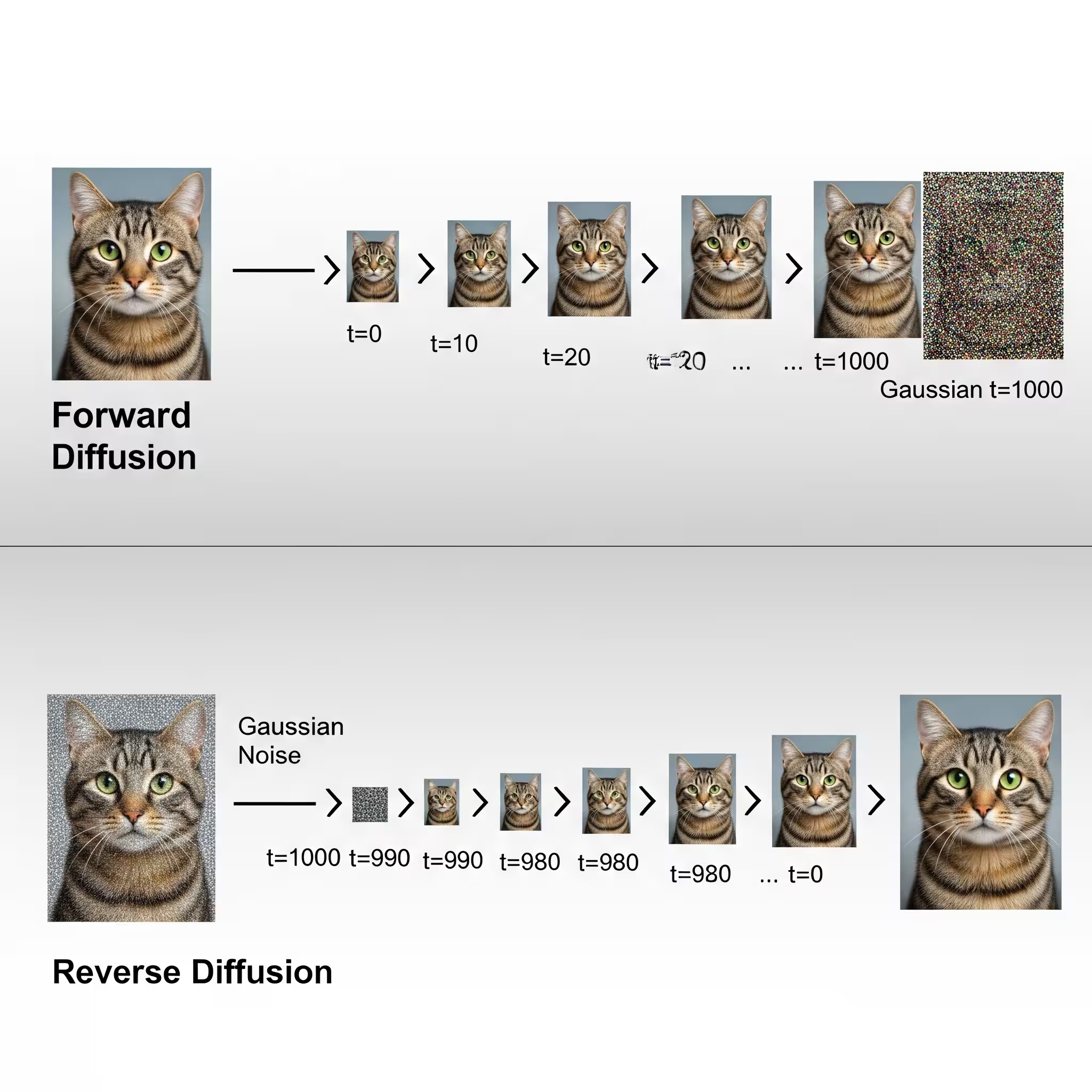
A diffusion model does not generate images directly.
Instead, it learns one very specific skill:
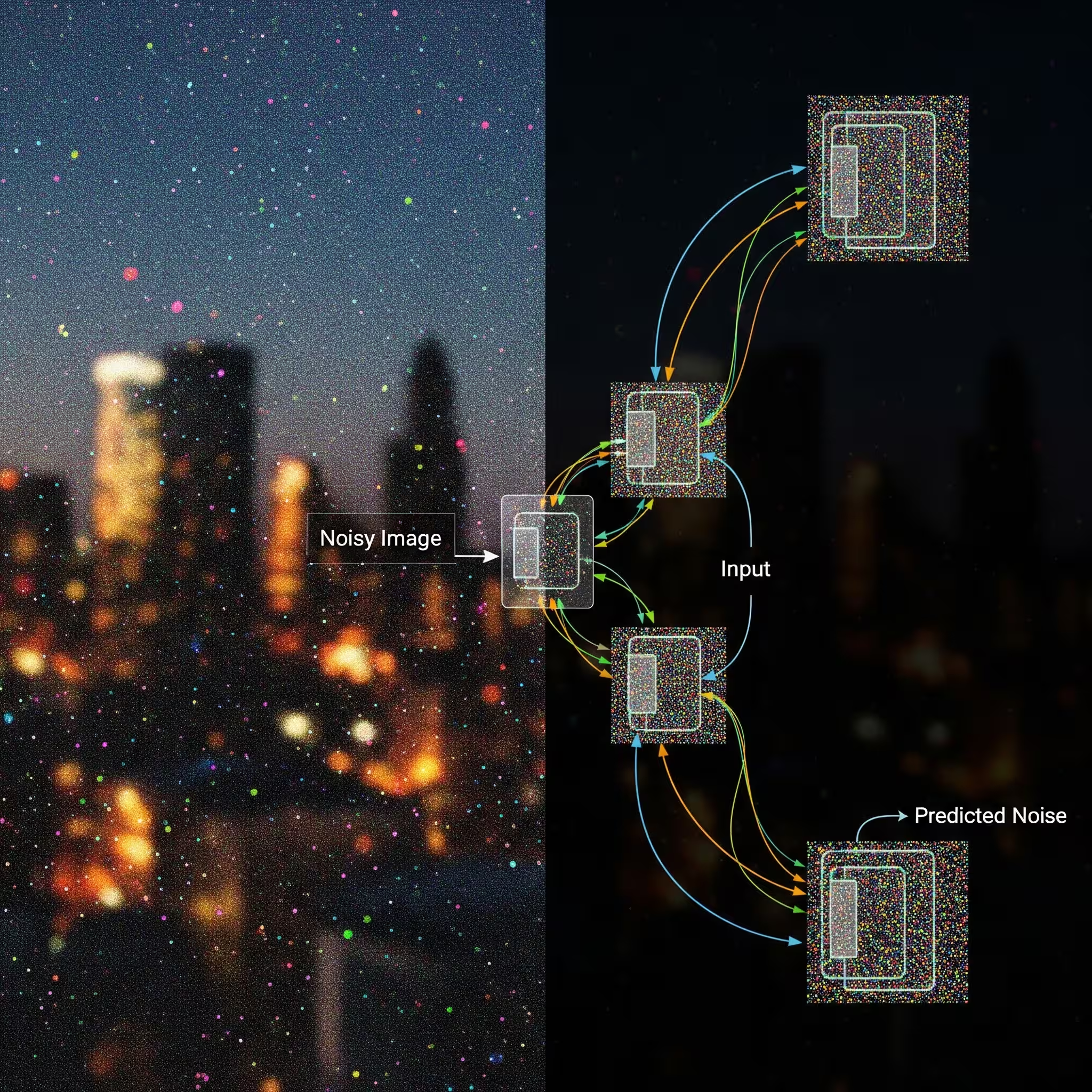
Given a noisy image, predict the noise that was added to it.
That’s it.
If you can do that reliably at every noise level, you can:
- start from pure noise
- repeatedly remove noise
- end up with a realistic image
This idea is borrowed from statistical physics and probability theory, not biology.
### The Forward Diffusion Process (Adding Noise)
The forward process slowly destroys information.
At timestep (t = 0), the image is clean.
At timestep (t = T), the image is pure Gaussian noise.
This happens gradually to avoid destroying structure too quickly.
### The Noise Schedule (Why It Matters)
We control how much noise is added at each step using a beta schedule.
import torch

def linear_beta_schedule(timesteps):
    beta_start = 0.0001
    beta_end = 0.02
return torch.linspace(beta_start, beta_end, timesteps)#### Explanation
betacontrols noise variance per step- Small values preserve structure early
- Larger values ensure complete destruction later
- Linear schedules are simple and stable for learning
More advanced models use cosine schedules, but the concept is identical.
### Sampling Noisy Images at Any Timestep
Instead of adding noise step-by-step, diffusion uses a closed-form equation:
[
x_t = \sqrt{\bar{\alpha}_t} x_0 + \sqrt{1 - \bar{\alpha}_t} \epsilon
]
This allows direct sampling at any timestep.
def q_sample(x_start, t, noise=None):
    if noise is None:
        noise = torch.randn_like(x_start)

    sqrt_alpha_hat = torch.sqrt(alphas_cumprod[t])[:, None, None, None]
    sqrt_one_minus = torch.sqrt(1 - alphas_cumprod[t])[:, None, None, None]

return sqrt_alpha_hat * x_start + sqrt_one_minus * noise#### Explanation
x_startis the clean imagenoiseis Gaussian noise- The model sees all corruption levels, not just extreme cases
This single equation makes diffusion computationally practical.
### What the Model Is Trained to Predict
The model does not predict images.
It predicts:
[
\epsilon_\theta(x_t, t)
]
Which means:
The noise that produced the current image.
Predicting noise instead of pixels:
- stabilizes training
- avoids blurry outputs
- aligns with maximum likelihood estimation
### The UNet Architecture
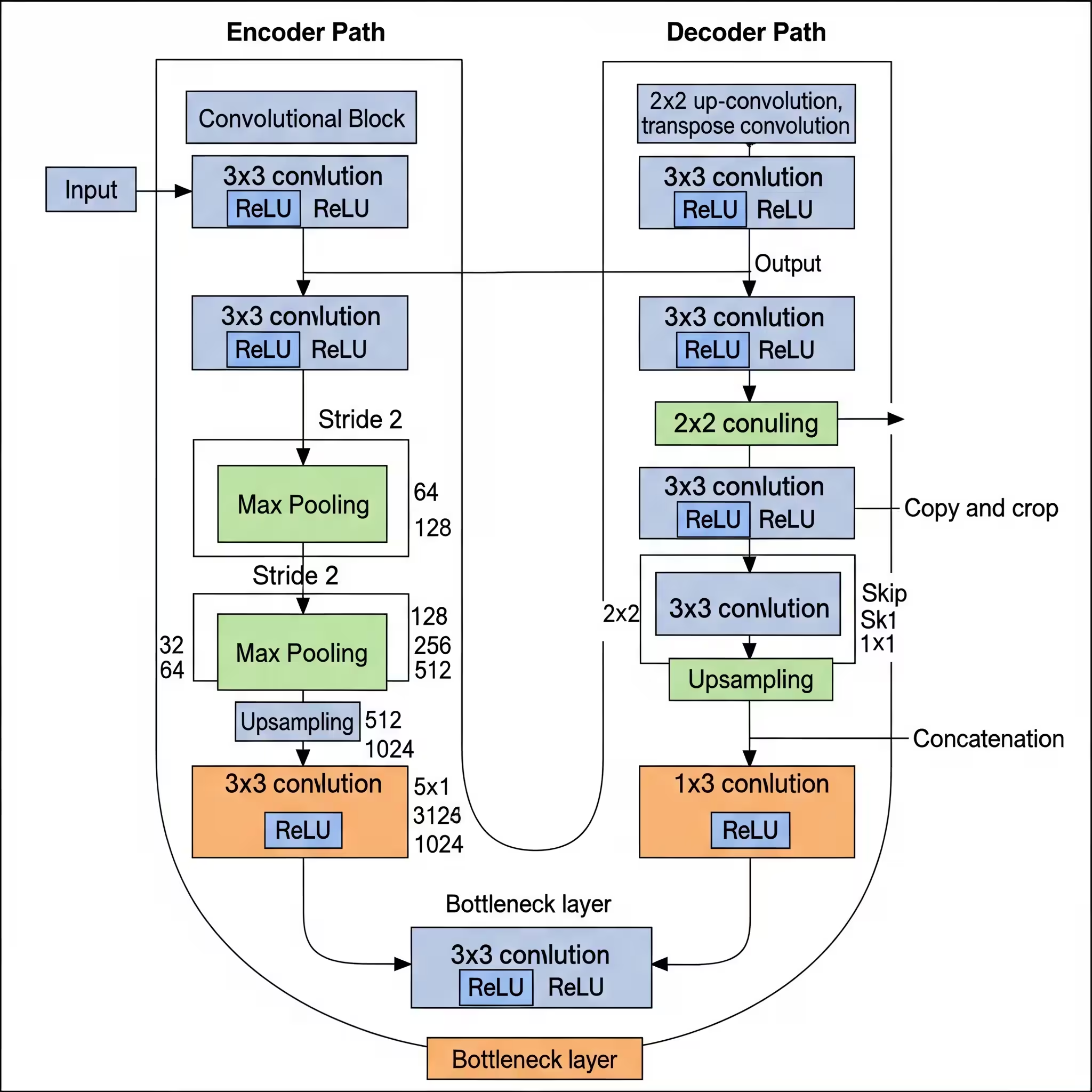
Diffusion models use UNets because they:
- preserve spatial information
- capture global context
- reconstruct fine details
import torch.nn as nn

class SimpleUNet(nn.Module):
    def __init__(self):
        super().__init__()

        self.down1 = nn.Sequential(
            nn.Conv2d(3, 64, 3, padding=1),
            nn.ReLU()
        )

        self.down2 = nn.Sequential(
            nn.Conv2d(64, 128, 3, padding=1),
            nn.ReLU()
        )

        self.up1 = nn.Sequential(
            nn.ConvTranspose2d(128, 64, 3, padding=1),
            nn.ReLU()
        )

        self.out = nn.Conv2d(64, 3, 1)

    def forward(self, x):
        d1 = self.down1(x)
        d2 = self.down2(d1)
        u1 = self.up1(d2)
        return self.out(u1)
This minimal UNet is enough to understand diffusion deeply.
### Loss Function and Training Objective
The training objective is simple:
def diffusion_loss(model, x_start, t):
    noise = torch.randn_like(x_start)
    x_noisy = q_sample(x_start, t, noise)
    noise_pred = model(x_noisy)
return nn.MSELoss()(noise_pred, noise)#### Why MSE?
- Noise is Gaussian
- MSE corresponds to maximum likelihood
- Predicting noise avoids instability
The model learns to reverse corruption — not to hallucinate images.
### The Training Loop
optimizer = torch.optim.Adam(model.parameters(), lr=1e-4)

for epoch in range(epochs):
    for images in dataloader:
        t = torch.randint(0, timesteps, (images.size(0),))
        loss = diffusion_loss(model, images, t)

        optimizer.zero_grad()
        loss.backward()
        optimizer.step()

print(f"Epoch {epoch} | Loss: {loss.item()}")#### What This Teaches the Model
- All noise levels are learned
- No discriminator needed
- Training is slow but stable
This stability is why diffusion replaced GANs.
### Reverse Diffusion (Image Generation)
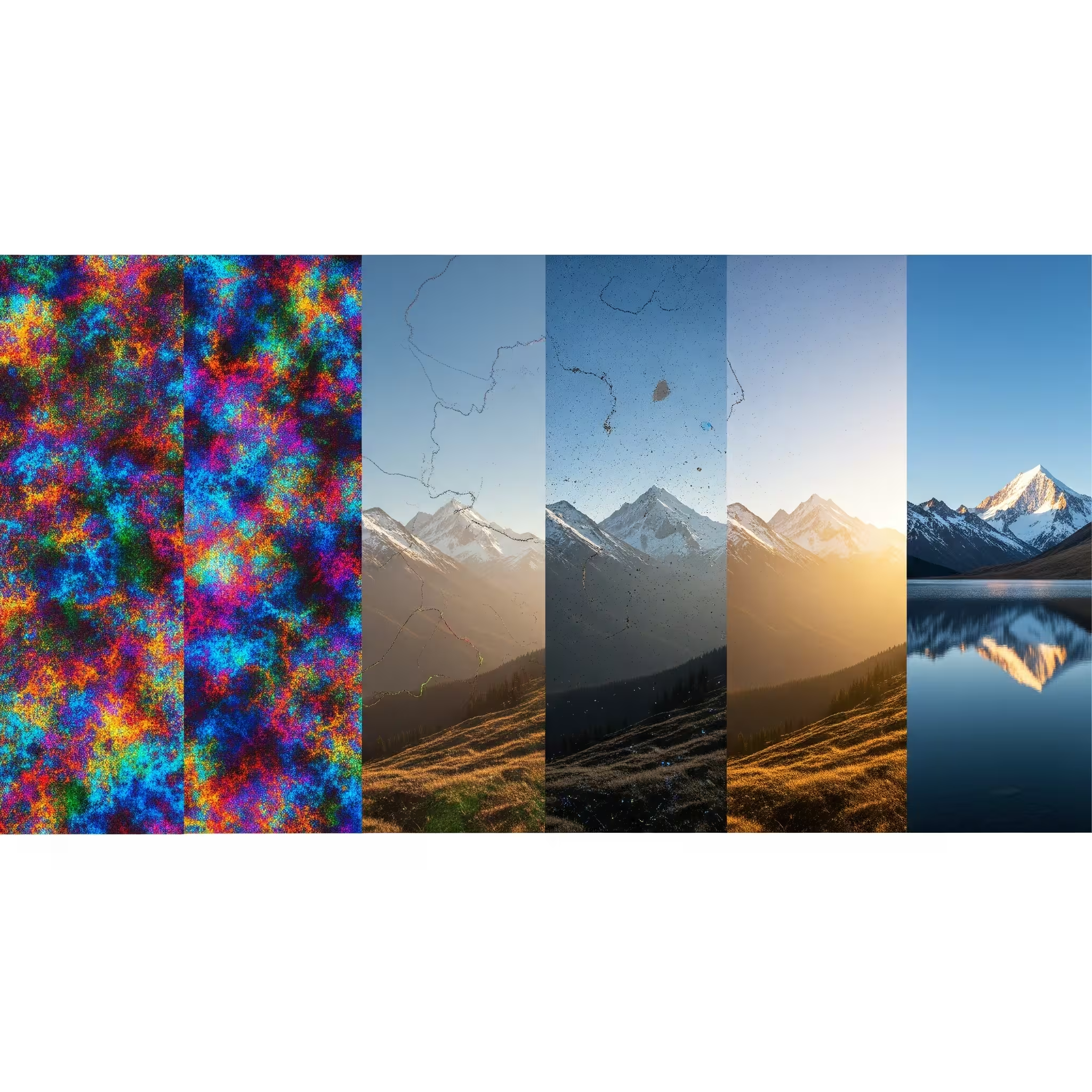
Image generation is the reverse of noise addition.
@torch.no_grad()
def sample(model, shape):
    x = torch.randn(shape)

    for t in reversed(range(timesteps)):
        noise_pred = model(x)

        alpha = alphas[t]
        alpha_hat = alphas_cumprod[t]
        beta = betas[t]

        x = (1 / torch.sqrt(alpha)) * (
            x - ((1 - alpha) / torch.sqrt(1 - alpha_hat)) * noise_pred
        )

        if t > 0:
            x += torch.sqrt(beta) * torch.randn_like(x)

    return x
This loop slowly reveals structure from randomness.
### Why Diffusion Models Actually Work
Diffusion models succeed because they:
- model the full data distribution
- avoid adversarial instability
- reduce generation to denoising
They trade speed for reliability.
### Final Thoughts
Diffusion models are not magic.
They are patience, math, and repetition.
If you understand this post, you understand the foundation of:
- Stable Diffusion
- DALL·E
- Imagen
This is Part 2.
Next comes conditioning, latent diffusion, and real-world scaling.