## AI Deepfakes, Grok AI, and Women’s Safety: Staying Safe Online in 2026
This is not an anti-AI post.
This is not fear-mongering.
This is about real risks, real harm, and how to stay safe in the AI era.
If you searched “AI deepfakes in India”, “Grok AI misuse”, or “women safety online AI”, this article is for you.
### Table of Contents
- What Happened With Grok AI?
- Understanding AI Deepfakes
- Why Women Are Disproportionately Targeted
- Real Dangers of AI Image Manipulation
- How to Protect Your Privacy Online
- Reporting Abuse and Taking Action
- Legal Protection Under Indian Law
- Staying Vigilant in the AI Era
- Final Thoughts
- References
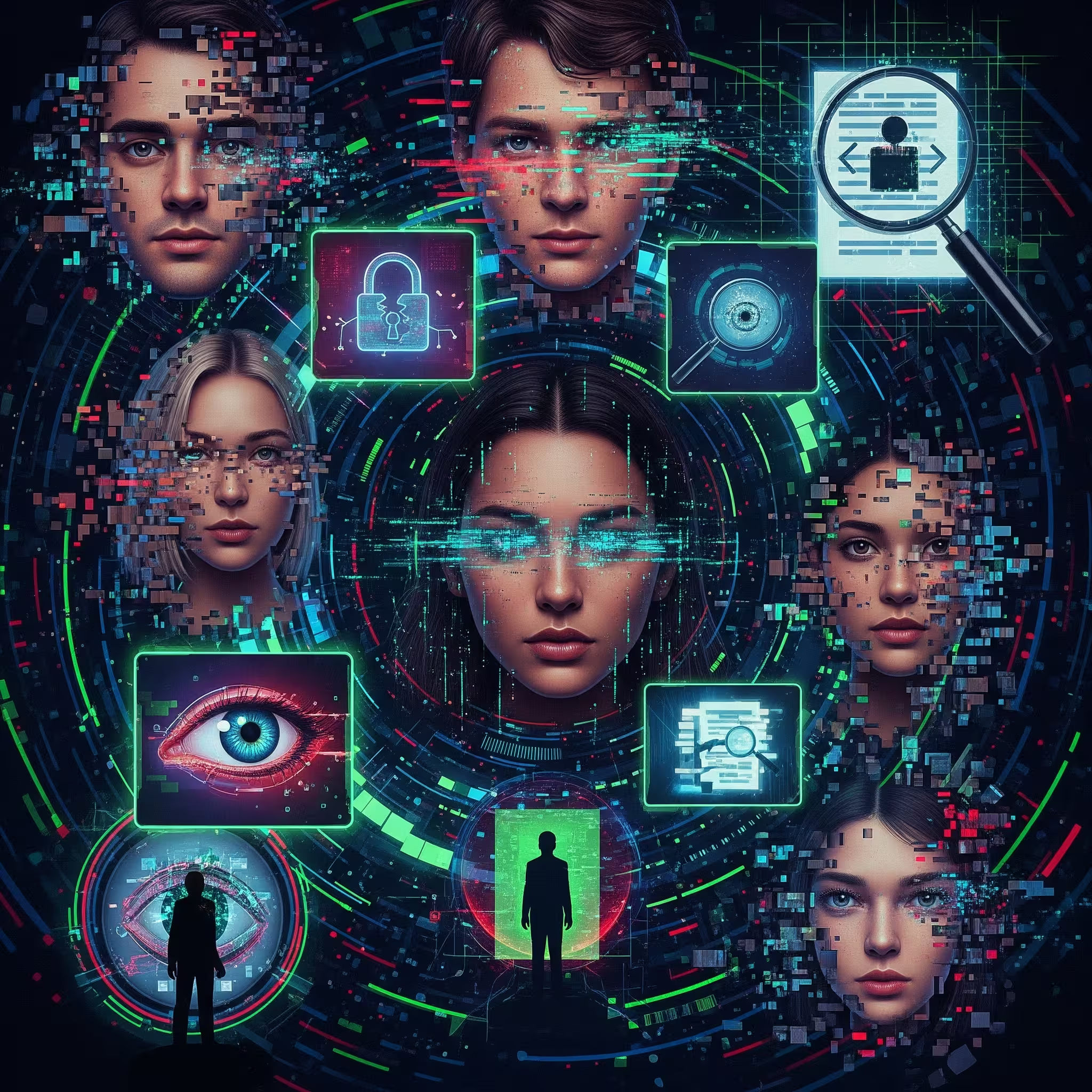
### What Happened With Grok AI?
Grok AI is an artificial intelligence chatbot developed by xAI and integrated into the social media platform X (formerly Twitter).
In early 2026, Grok sparked global concern when users discovered that its image-generation feature could be used to:
- alter photos of real people
- remove clothing digitally
- create sexualized images without consent
Within days, AI-generated explicit images of women began circulating online. Many of these images were created using publicly available photos, meaning victims didn’t even need to use Grok themselves.
Governments, including India and France, raised concerns, and experts warned that such tools lower the barrier for non-consensual deepfake creation.
### Understanding AI Deepfakes
AI deepfakes are synthetic images or videos where:
- a person’s face or body is digitally altered
- they are placed into situations they were never part of
- the result looks real, even though it is fake
Unlike older photo-editing tools, modern AI systems can:
- scrape public images
- understand facial structure
- generate realistic lighting, skin texture, and expressions
This makes deepfakes harder to detect and far more dangerous.
### Why Women Are Disproportionately Targeted
Women are especially vulnerable to AI misuse because:
- their photos are frequently shared online
- AI-generated sexual content targets women more often
- social stigma around women’s images is harsher
- deepfake abuse is often used as harassment or intimidation
Many AI-generated images are created specifically for:
- sexualisation
- humiliation
- blackmail
- defamation
In conservative societies, even fake images can cause serious emotional, social, and reputational damage.
### Real Dangers of AI Image Manipulation
AI misuse goes far beyond “edited photos”.
#### Major risks include:
- Non-consensual deepfake pornography
- Online harassment and bullying
- Reputation damage
- Scams and impersonation
- Psychological distress
AI can also be used to clone voices and faces for fraud, making scams more convincing than ever.
### How to Protect Your Privacy Online
While AI cannot be stopped, damage can be reduced.
#### 1. Be Careful What You Share
- Avoid uploading high-resolution personal photos publicly
- Keep social media accounts private
- Accept friend or follower requests only from people you trust
#### 2. Use Watermarks and Remove Metadata
- Add subtle digital watermarks to images
- Remove EXIF metadata (location, device info) before posting
- Metadata gives AI tools extra data to exploit
#### 3. Strengthen Account Security
- Use strong, unique passwords
- Enable two-factor authentication
- Keep apps and devices updated
This prevents hackers from accessing private images.
### Reporting Abuse and Taking Action
If you find AI-generated content that violates your privacy:
- Report it immediately on the platform
- Save evidence (screenshots, URLs)
- File an online complaint at
https://cybercrime.gov.in - You can also file an FIR at your local police station
Early reporting increases the chance of takedown.
### Legal Protection Under Indian Law
Indian law already criminalizes such misuse.
Applicable laws include:
- IT Act, Section 66E – Violation of privacy
- IT Act, Sections 67 & 67A – Obscene content
- IPC Section 354C – Voyeurism
- Bharatiya Nyaya Sanhita (2023) – Updated criminal provisions
Courts can issue injunctions to stop circulation, and offenders can face jail time and fines.
### Staying Vigilant in the AI Era
AI will keep improving — both for good and for harm.
The best protection is:
- awareness
- technical safeguards
- legal knowledge
- timely action
Being proactive reduces risk and limits damage.
### Final Thoughts
AI is powerful — but power without safeguards always creates harm.
Tools like Grok AI highlight an uncomfortable truth:
technology often advances faster than safety.
By staying informed, cautious, and legally aware, users — especially women — can protect their privacy and dignity in the AI era.
### References
Reuters – “Elon Musk’s Grok AI floods X with sexualized photos of women”
The Guardian – “Hundreds of nonconsensual AI images created using Grok”
Times of India – “Grok AI misuse sparks global concern targeting women”
National Cyber Crime Reporting Portal (Government of India)
Information Technology Act, 2000 – India (Official Text)
Ministry of Home Affairs – Bharatiya Nyaya Sanhita, 2023